
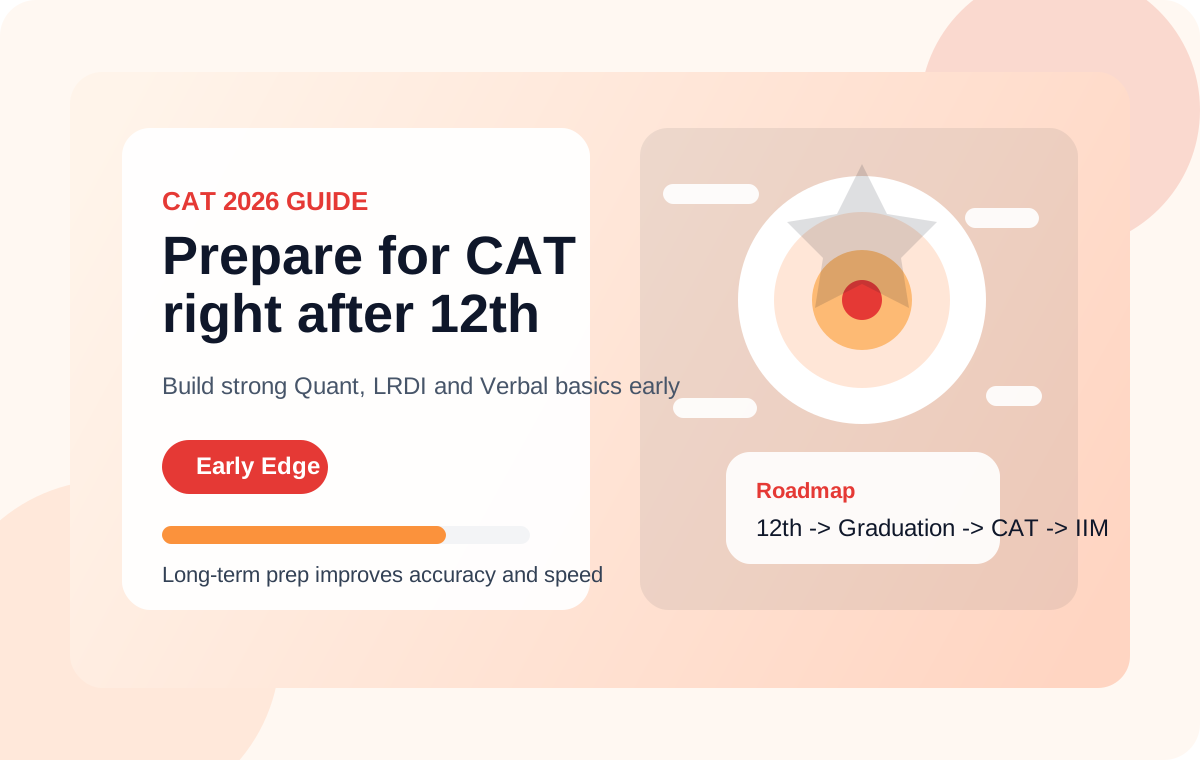
How to prepare for the CAT exam after the 12th? Preparation of the CAT exam after the 12th can be done by building strong fundamentals in Quantitative Aptitude, Logical Reasoning, and Verbal Ability.
Why Start CAT Preparation Early
Preparation of the CAT exam after the 12th can be a good idea as it provides more time to students to strengthen their concepts. Instead of rushing during the final year of graduation, you can build a steady base and improve your problem-solving ability over time.
Early preparation of the CAT exam can help students:
- Build strong concepts
- Improve speed and accuracy
- Stay ahead of the competition
- Students who prepare early perform better in the CAT exam
Understand the Career Roadmap First
CAT is generally attempted during the final year of graduation or after graduation because admission to IIMs and top MBA colleges requires a bachelor's degree. That means if you are in class 12 or have just completed it, your immediate goal is not to appear for CAT right now, but to prepare in a smart and structured way so that you are far stronger than the average aspirant when your actual CAT year arrives.
A practical roadmap looks like this: complete class 12, choose a graduation course that fits your interests, continue academic consistency, improve aptitude and communication skills throughout college, and then attempt CAT with strong fundamentals, mock test exposure, and interview readiness.
Build the Three Core CAT Areas
1. Quantitative Aptitude
Start with arithmetic, percentages, ratio and proportion, averages, profit and loss, time and work, time speed distance, algebra, geometry, and number systems. Do not jump straight into advanced shortcuts. Strong basics always create better speed later.
2. Logical Reasoning and Data Interpretation
Practice seating arrangements, puzzles, arrangements, games and tournaments, tables, charts, and caselets. LRDI becomes easier when you learn to break a set into conditions, organize data neatly, and stay calm under time pressure.
3. Verbal Ability and Reading Comprehension
Read newspapers, editorials, non-fiction articles, and long-form essays regularly. Build vocabulary in context, improve grammar naturally, and practice reading for argument, tone, inference, and structure instead of reading only for facts.
Best Preparation Strategy After 12th
- Choose consistency over intensity. Study a little every week rather than doing random heavy prep.
- Read every day. Strong reading habits become a major advantage in CAT verbal and in interviews later.
- Maintain graduation marks. Academic profile matters for many top B-schools.
- Work on calculation speed with mental math and approximation.
- Solve aptitude questions gradually and track weak chapters.
- Join guidance or mentorship when you need structure, discipline, and feedback.
What Should You Do in Each College Year
First Year
Focus on basics in arithmetic, reading habits, grammar improvement, and puzzle solving. Develop study discipline and keep your college scores healthy.
Second Year
Move into intermediate CAT topics, sectional practice, and regular timed drills. Start understanding CAT exam pattern, cutoffs, and the difference between accuracy practice and speed practice.
Final Year
Shift into full CAT mode with mocks, analysis, revision, test-taking strategy, and preparation for WAT, GD, and PI rounds. This is the stage where your early preparation starts giving visible results.
Common Mistakes to Avoid
- Ignoring graduation academics while preparing for CAT
- Starting with too many advanced books without basics
- Memorizing tricks without concept clarity
- Neglecting reading habits and communication skills
- Comparing progress with final-year CAT aspirants too early
Final Advice for CAT 2026 Aspirants
If you are serious about getting into top IIMs, starting after the 12th is a smart long-term decision. You do not need to prepare like a full-time CAT aspirant immediately. Instead, use these early years to strengthen concepts, develop reading depth, sharpen reasoning skills, and maintain a strong academic profile. By the time your actual CAT attempt arrives, you will be far more confident, accurate, and exam-ready.